 PaisaMaps for business
Use case · Credit & affordability
An area signal for lending.
Add documented, area-level affordability to how you source, size and plan, alongside your own customer data.
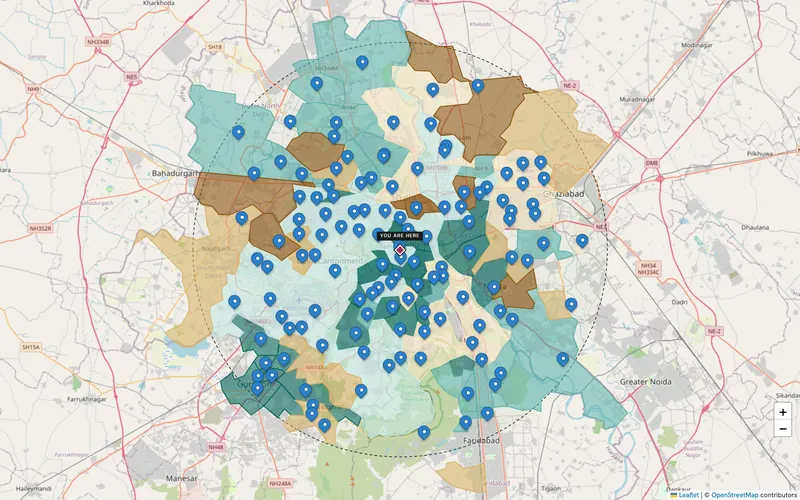
Before you start
An area signal has an area's limits
It tells you
- How affluent and how banked a pincode is, compared with others
- Where a product's market is larger or smaller
It doesn't tell you
- Anything about one applicant
- Income measured at household level: these are modelled estimates
How it's done
From signals to your model
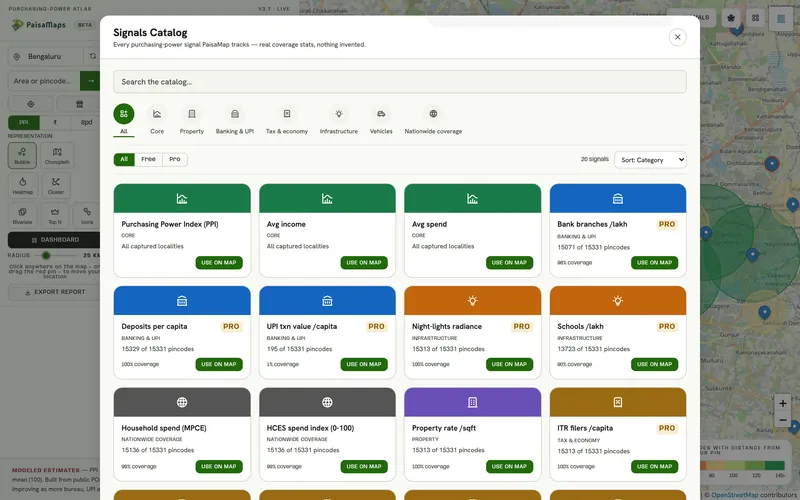
Choose signals
Income, spend, branches, deposits, UPI value, tax filers.
Export by pincode
CSV, Excel, JSON, or an API key for refreshes.
Join to your book
Match on pincode in your own systems.
Review and monitor
Through your model governance; refresh as sources update.
Worked example
Phasing a microfinance expansion
- ExportPurchasing power, branches per lakh and deposits per person for the state.
- ScoreRank pincodes on spending power against banking density.
- OverlayJoin to the MFI's own target-segment data on pincode.
- PhaseYear-one branches in the top-ranked areas.
The decision
Branch phasing follows areas where spending power is ahead of banking supply; the area features go through model review before use.
What the team walks away with
- A phased branch plan
- Area features joined on pincode
- A documented source for every signal
By industry
How each industry uses it
| Industry | What they do with it |
|---|---|
| Lenders, NBFC & fintech → | Adds area affordability as a feature next to bureau and customer data. |
| Agencies & consultants → | Supplies documented area features for a lender client's model. |
Signals that matter here
Which signal answers which question
Every plan sees purchasing power, income and spend. These are the signal groups that move this decision.
| Signal group | What it tells you | The decision it feeds |
|---|---|---|
| Purchasing power | How much a typical household earns and spends, and how that ranks in its state | Where your price point has enough customers; which sites to shortlist |
| Banking & UPI | How banked and how digitally active an area is | Where credit, payments or premium products will be adopted first |
| Tax & economy | How many people file income tax, and the local business base | Formal-income depth for lending; B2B and SME demand |
Each signal's source and level (pincode, district or state) is listed on the signals page.
What you walk away with
A documented area input
You get
- Pincode-level income and spend estimates
- Banking and tax signals with their levels
- Exports and an API
You don't need
- To share any customer data with us
- A new data vendor integration
- Household-level surveys
Keep exploring
Where to go next
Lenders, NBFC & fintech
Banks, NBFCs, MFIs and fintechs use pincode income, spend and banking depth to prioritise sourcing, size products by region…
Explore →
Agencies & consultants
Strategy firms, consultancies and research and media agencies run each client as its own company, with pincode-level market…
Explore →Data API & exports
Export purchasing power, income, spend and signals by pincode as CSV, Excel or JSON, or pull them with an API key. Higher…
Explore →